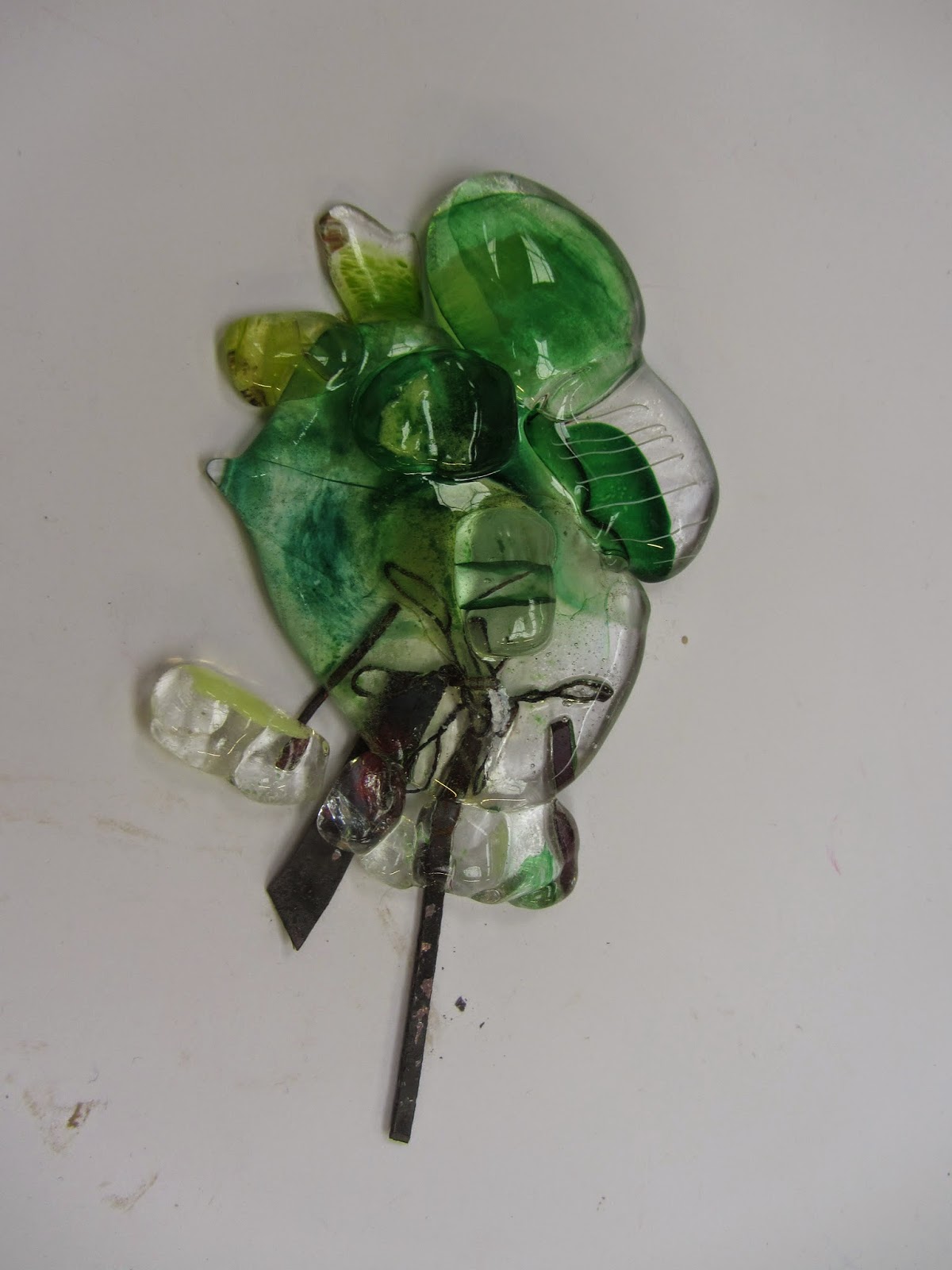
Glass powder and flux heated from underneath to give a textured finish
Layer of hot glass, pieces of copper, more glass dropped on top
Copper wire encapsulated in hot glass
Copper wire encapsulated in fused glass
Copper sheet kiln fired with scrap glass pieces and coloured glass powder
Copper sheet kiln fired with glass powder on and to the side of it.
Through my testing I have noticed a familiar theme, which is mixing copper with glass. I think this could be a good theme to take forwards, experimenting more with shaping the copper before it gets put in the glass, and possibly patinating or texturing it after.
Showing posts with label copper. Show all posts
Sunday, 12 April 2015
Kiln Glass: Fusing
I collected green and orange glass from the hot shop scrap bins (clear glass is recycled but bits with colour are put in a bin which we can use for fusing, casting, slumping etc.) I chose to stick with this colour scheme as these are the colours of moss I have been looking at. I arranged the scraps on a kiln shelf which had been prepared with batt wash to stop the glass sticking, and to give them a smooth back. I arranged the pieces into shapes, and also put some bits of copper under the glass, inbetween layers and on the top, to see how it would react with the glass and the heat of the kiln.
These were just test pieces, but if i wanted to further this technique, I could make specific components in the hot shop, to then fuse together in the kiln. My favourites were the ones I made from the glass powder, as these had a more unpredictable texture, where the powder had melted and separated and left holes and gaps.
The copper worked well, changing colour to give different reds, maroons and black. I could cold work both the glass and copper, to put texture onto the glass or to change the colour of the exposed parts of copper to their original colour.
I feel that some of these pieces are fairly boring, as I controlled them too much. I think the ones that did something unexpected were good, as they made me think about where else I could take it, rather than creating a piece I was expecting.
These were just test pieces, but if i wanted to further this technique, I could make specific components in the hot shop, to then fuse together in the kiln. My favourites were the ones I made from the glass powder, as these had a more unpredictable texture, where the powder had melted and separated and left holes and gaps.
The copper worked well, changing colour to give different reds, maroons and black. I could cold work both the glass and copper, to put texture onto the glass or to change the colour of the exposed parts of copper to their original colour.
I feel that some of these pieces are fairly boring, as I controlled them too much. I think the ones that did something unexpected were good, as they made me think about where else I could take it, rather than creating a piece I was expecting.
Labels:
copper,
fusing,
glass,
glass fusing,
green,
hot glass,
hot shop,
kiln,
kiln glass,
metal,
mixed materials,
mixed media,
moss,
nature,
orange
Hot Glass: Prunts, Inclusions and imprints
I first put copper in glass by dropping a blob of hot glass onto a graphite sheet, dropping copper onto that, then putting more glass over the top to trap the copper inside. This works, and I then moved onto doing this in 3D rather than on a flat surface.
The technique was the same, the second glass layer is dropped on top, as if the glass with copper on is put back in the furnace it could easily fall off and contaminate the glass.
I used the same method to create a hollow form with copper inclusions and colour.
I talked to simon about getting texture onto the glass and he told me about prunts, which are stamps used on hot glass. I used a raspberry shaped graphite stamp to shape a blob of glass.
I think a collection of these could be a nice mini installation.
I then tried using real moss, and other bits of organic matter, to make imprints in glass. I dropped the glass on top of the pieces, which made them catch fire and smoke a lot, but the glass cooled quick enough to capture the texture before the plants burnt away.
The technique was the same, the second glass layer is dropped on top, as if the glass with copper on is put back in the furnace it could easily fall off and contaminate the glass.
I used the same method to create a hollow form with copper inclusions and colour.
I talked to simon about getting texture onto the glass and he told me about prunts, which are stamps used on hot glass. I used a raspberry shaped graphite stamp to shape a blob of glass.
I think a collection of these could be a nice mini installation.
I then tried using real moss, and other bits of organic matter, to make imprints in glass. I dropped the glass on top of the pieces, which made them catch fire and smoke a lot, but the glass cooled quick enough to capture the texture before the plants burnt away.
Labels:
copper,
glass,
glass blowing,
hot glass,
hot shop,
imprint,
inclusion,
moss,
organic matter,
plants,
prunt,
prunts
Metalwork: Enamelling on copper
I decided to try using my hot shop colour powders on copper, as I know that copper and glasma have very similar coefficients of expansion, and so can be used together. The problem I was most worried about was it not sticking to the copper. to combat this I thoroughly cleaned the copper so there were no contaminants on the surface. I was right to worry, as my first attempt was unsuccessful, the enamel flaking off the surface soon after it cooled. I thought this was due to the copper building up a layer of oxide, and the powder stuck to that instead of the copper itself. I then thought that to combat this I could use borax flux to stop the oxide building up (flux is what keeps the metal clean and enables solder to stick to it). I first mixed the powder with water and flux and painted it on to the copper.
I heated up the piece from underneath (to heat the copper rather than the enamel) and the flux bubbled up. I liked the effect this gave, as it moved the powder out of a flat layer and into a very interesting texture.I then used enamels that are designed for use in a kiln on sheet glass, which have a lower melting temperature. I textured the copper in the rolling mill then painted on the enamel and heated it with a blowtorch from underneath.
These stuck without flux, and stayed where I painted them on, so were a lot more controllable, but not as textured as the powder pieces.
Labels:
copper,
enamel,
enamelling,
flux,
glass,
metalwork,
powder,
powdered glass
Monday, 10 February 2014
Metalwork: Making wire.
Wire is a very versatile material in metalwork, and I have now learnt how to make my own wire the diameter and shape I want it. This means I can make the wire to suit the piece I want to make, rather than changing the piece depending on the wire. I started off with a rod of copper, about 4mm diameter and about 6cm long. I used the rolling mill to roll it down, making the diameter smaller and a slight diamond shape. This also made it longer because the metal was being squashed through the roller.
I then used a draw plate to make the wire thinner, and give it a square cross section. I decided to make it square because wire is generally round, and I thought square would be more interesting because it could be twisted to create different effects.
The end of the wire is a little bit chewed up because of the pliers I used to pull it through the draw plate, so this little bit is unusable, but could be made into something else or put in a scrap pile to melt down later.
I then used a draw plate to make the wire thinner, and give it a square cross section. I decided to make it square because wire is generally round, and I thought square would be more interesting because it could be twisted to create different effects.
The end of the wire is a little bit chewed up because of the pliers I used to pull it through the draw plate, so this little bit is unusable, but could be made into something else or put in a scrap pile to melt down later.
Tuesday, 8 October 2013
Glasswork: using cold glass.
This week in glass we were doing more work using cold glass. I designed and made a tile from two sheets of glass, with copper wire and copper foil inside for the decoration. I wanted to stay with the nature theme so I cut leaves out, and then used the copper wire and small pieces of copper foil to make it look as though it was windy, like the leaves were being blown about.
i washed and dried the glass sheets carefully, so as to not leave any marks on them, because the marks would stay there through the firing.
The tiles were put in the kiln on ceramic fibre paper, and were fired up to 810 degrees, so the glass sheets were fully fused together.
We then filled the moulds we made in the last session. for the half-mould, I filled it up to about twice its depth, because it needs more glass than it looks like it should to make up for the air in between the glass pieces.

i washed and dried the glass sheets carefully, so as to not leave any marks on them, because the marks would stay there through the firing.
The tiles were put in the kiln on ceramic fibre paper, and were fired up to 810 degrees, so the glass sheets were fully fused together.
We then filled the moulds we made in the last session. for the half-mould, I filled it up to about twice its depth, because it needs more glass than it looks like it should to make up for the air in between the glass pieces.
these were then put into the kiln to fire, so the pieces of glass would melt and fill the mould.
I weighed out the glass for my rose mould, using a glass:wax ratio of 2.55:1. my wax weighed 87g, and so i calculated that i would need 221 grams of glass. I weighed out 225, in case some of the glass stuck to the inside of the reservoir instead of all flowing into the mould. These were also put into a kiln, on ceramic fibre paper in case any of the glass overflowed and dripped onto the kiln floor.
Wednesday, 10 July 2013
Folded squares: Making jewellery
I started by setting out my copper squares with other types of squares to spell out words. I decided to use tin plate steel to make some squares, and I acid etched one side, so the inside was different when folded. I spelled out the word 'hide' using the braille alphabet
I then decided to try some clay squares using the same folding method, but I found these were more curved because of the nature of the clay. I enameled the clay to show the cross pattern more clearly. I had to try to make the clay squares the same size as the metal ones, and this was fairly difficult because clay bends in a different way to metal, and it also shrinks during firing.I then decided that it would be better if there was a colour scheme, so it wasn't just random, so I decided to take the warm colours from the copper and brass, and use enamels in these colours on the clay squares.
The clay squares on this one spell out 'unnoticed'. I stuck the squares together with masking tape to make sure they were lined up, before sewing them onto a fabric base. I stitched wadding inside the fabric, to make a padded base. I then sewed the edges together, to create a cuff.
I tried to make the stitching as invisible as possible, so the pattern wasn't interrupted by the seam.
I used the same method to make two other pieces, a bracelet and a necklace, spelling out 'hide' and 'observe'
Subscribe to:
Posts (Atom)