Showing posts with label metal. Show all posts

Sunday, 12 April 2015

Mixing Glass and Copper

 Glass powder and flux heated from underneath to give a textured finish
 Layer of hot glass, pieces of copper, more glass dropped on top
 Copper wire encapsulated in hot glass
 Copper wire encapsulated in fused glass
 Copper sheet kiln fired with scrap glass pieces and coloured glass powder
Copper sheet kiln fired with glass powder on and to the side of it.

Through my testing I have noticed a familiar theme, which is mixing copper with glass. I think this could be a good theme to take forwards, experimenting more with shaping the copper before it gets put in the glass, and possibly patinating or texturing it after.

Kiln Glass: Fusing

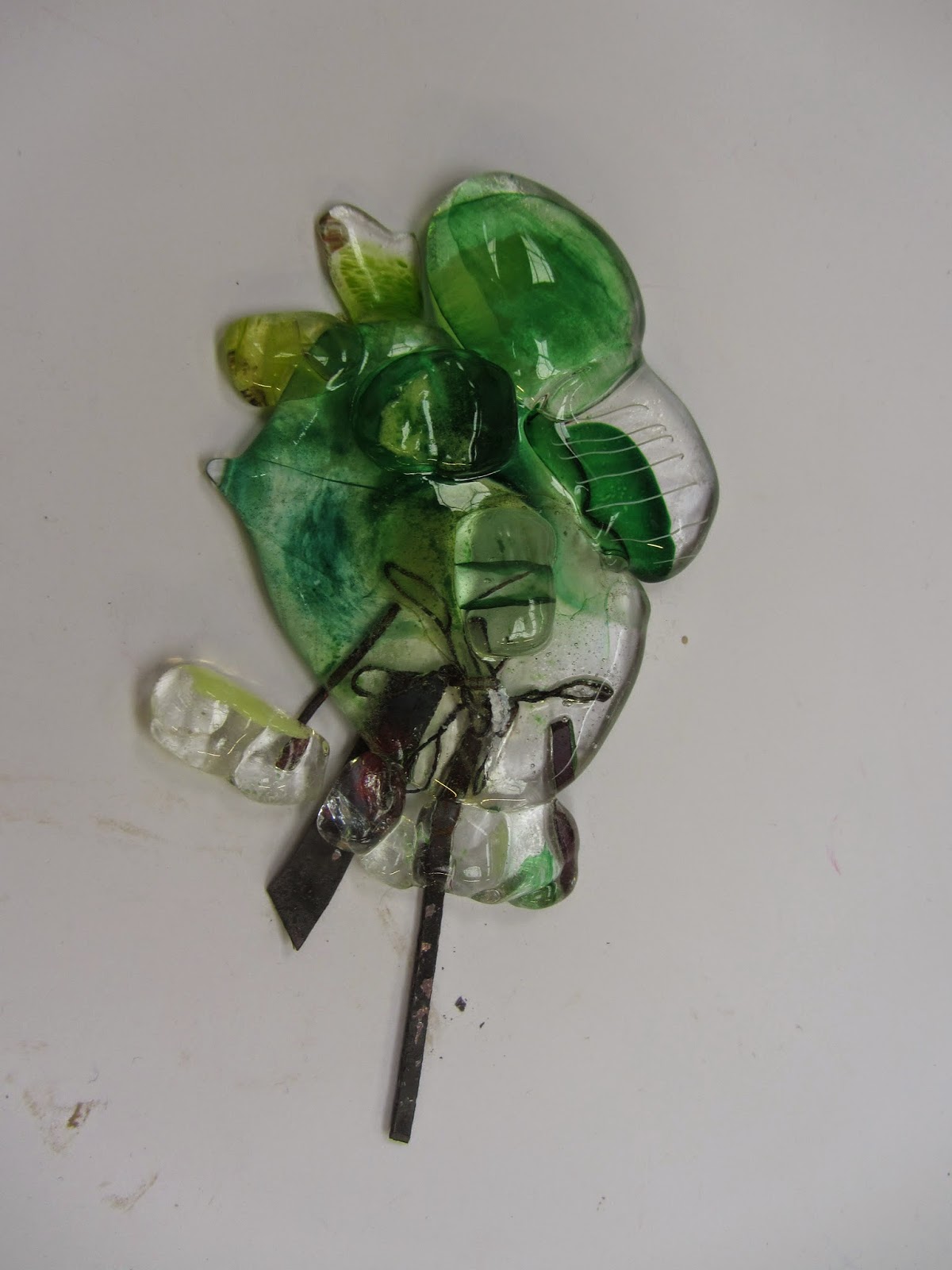
I collected green and orange glass from the hot shop scrap bins (clear glass is recycled but bits with colour are put in a bin which we can use for fusing, casting, slumping etc.) I chose to stick with this colour scheme as these are the colours of moss I have been looking at. I arranged the scraps on a kiln shelf which had been prepared with batt wash to stop the glass sticking, and to give them a smooth back. I arranged the pieces into shapes, and also put some bits of copper under the glass, inbetween layers and on the top, to see how it would react with the glass and the heat of the kiln.
These were just test pieces, but if i wanted to further this technique, I could make specific components in the hot shop, to then fuse together in the kiln. My favourites were the ones I made from the glass powder, as these had a more unpredictable texture, where the powder had melted and separated and left holes and gaps.


The copper worked well, changing colour to give different reds, maroons and black. I could cold work both the glass and copper, to put texture onto the glass or to change the colour of the exposed parts of copper to their original colour.


I feel that some of these pieces are fairly boring, as I controlled them too much. I think the ones that did something unexpected were good, as they made me think about where else I could take it, rather than creating a piece I was expecting.


Monday, 10 February 2014

Metalwork: Making wire.

Wire is a very versatile material in metalwork,  and I have now learnt how to make my own wire the diameter and shape I want it. This means I can make the wire to suit the piece I want to make, rather than changing the piece depending on the wire. I started off with a rod of copper, about 4mm diameter and about 6cm long. I used the rolling mill to roll it down, making the diameter smaller and a slight diamond shape. This also made it longer because the metal was being squashed through the roller.

I then used a draw plate to make the wire thinner, and give it a square cross section. I decided to make it square because wire is generally round, and I thought square would be more interesting because it could be twisted to create different effects.
The end of the wire is a little bit chewed up because of the pliers I used to pull it through the draw plate, so this little bit is unusable, but could be made into something else or put in a scrap pile to melt down later.


Monday, 14 October 2013

Metalwork: Soldering and decorating the ring

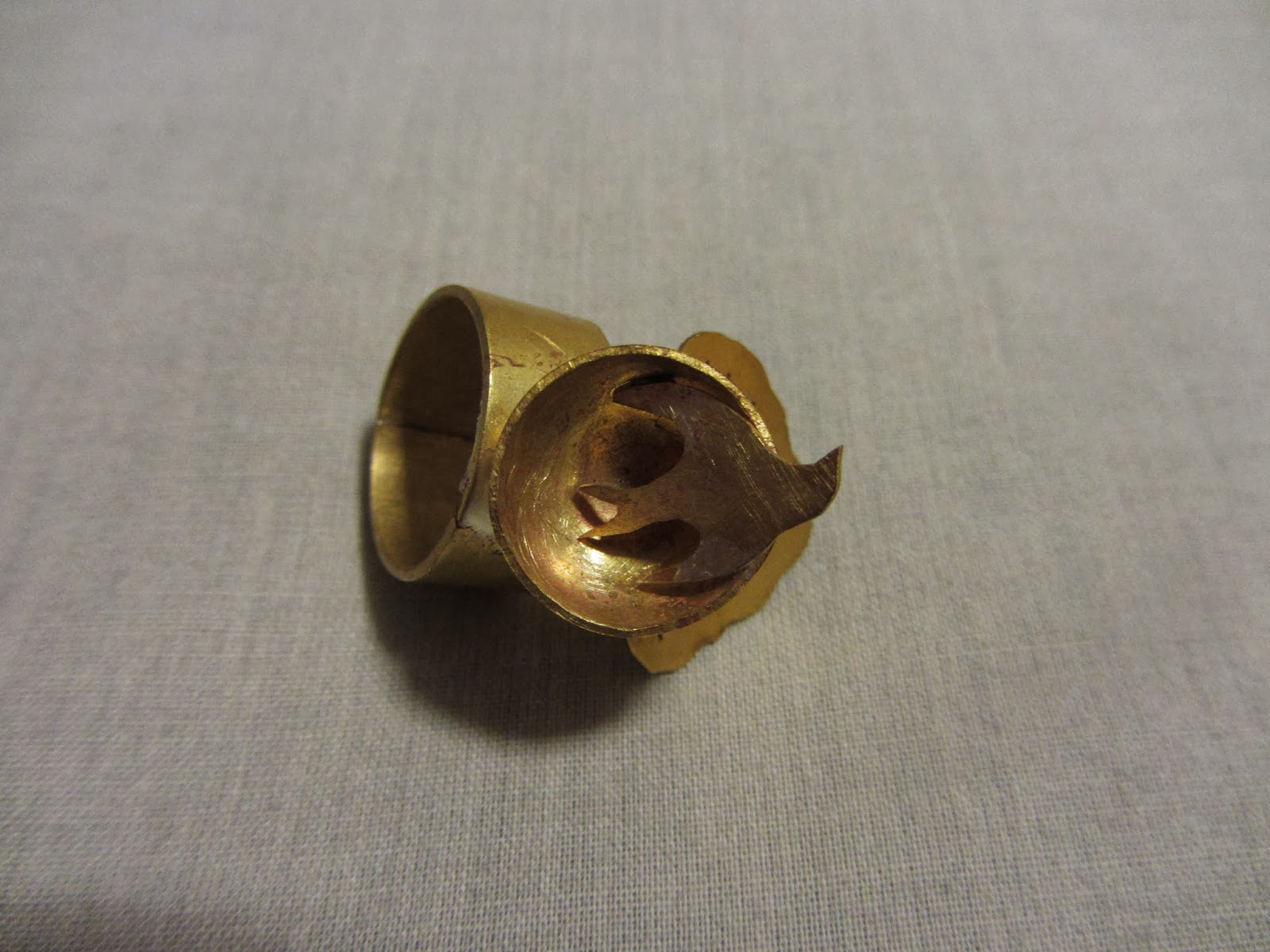
i decide my half sphere would be a birds nest, so i used a piercing saw to cut out the shape of a swallow. i first cut out the basic outline, then cut the 'v' out of it's tail. i had to be very careful on corners to make sure i didn't turn the saw too suddenly, which would snap the blade.
 I then cut out a tree shape, using cut lines to show the branches.

 I soldered all the pieces together, first soldering the tree to the inside of the ring, so it came out sideways, and then I soldered the bird into the nest. The next bit was quite difficult, because i had to solder the nest onto the ring, without disturbing any of the joints i had already soldered. i used the bricks to hold the ring and the nest in the right position while i soldered them.
 I quenched the whole ring and pickled it in the acid to take the flux off. This is the finished ring. I hope to polish it some more so the surface is more even and shiny.


Metalwork: making a ring and a half sphere.

Our first project in metalwork was a ring, with a half sphere on top, and another ornament or decoration of some sort. the first step was to cut a brass strip to the right size using a piercing saw. I used my finger circumference, then added the thickness of the metal multiplied by pi to get the length I would need for the ring to fit me. I then bent this around so the ends met, to be soldered together later. I then started on my half sphere. I drew a circle using a compass, and cut it out using the piercing saw.

I filed the edges to make them not as sharp. Then i had to shape the circle into a half sphere, or bowl shape. i did this using a doming block and punches. I moved from the bigger dents to smaller ones, so it got more domed as i went, and it got smaller.

I then soldered the edges of my ring together, making sure they were lined up well and had plenty of flux so the solder would flow in the right place. I then cleaned it in the acid to get all the flux off.
To make the ring round, I used a mallet and a ring stake to gently shape it without spoiling the texture of the metal or distorting it in any way.

Wednesday, 10 July 2013

Metalwork: More enamel.

I really liked the effect of the enamel in folded copper squares, so I decided to make some more, to place in a grid, so that they create a pattern together
I might also try hiding a pattern in this pattern, possibly having a few squares different, maybe brass or a different technique.

Sunday, 24 March 2013

Metalwork: Creating pattern on copper


 First, I used punches and a hammer to create a pattern, based on the pattern found on brick walls and paved floors. I was careful to make sure the grooves were continuous and all the same depth. I then used a wooden mallet to make sure it was flat without distorting the grooves.
 I painted on flux, and then heated it up with a blowtorch and touched solder to the surface. Unfortunately, it didn't spread out, it just stayed as a large blob in the corner, which is not what I wanted.
 I then pickled it in the acid before adding more flux (lots and lots of flux) and heating it up again. Thankfully, this time the solder spread out and covered most of the surface. I thought about putting more solder on, to cover all of the pattern, but I decided to leave some of the indents solder-free, because it reminded me of when cement falls out of walls, and I quite liked the look of it.
 I pickled it in the acid again before using the linisher to take the solder off the surface of the copper, so that the solder was only left in the grooves and it left a flat surface.
 I then used wet and dry paper to remove the tiny scratches the linisher had left, before buffing it and polishing it. I like this outcome, because the pattern is flush to the surface, and at first you only see the grooves in the corner, then you have to look closer to see the rest of the pattern.