Thursday, 11 July 2013

Macro Photography: Shield Bug

 I've always loved insects and creepy crawlies, and they're one of my favourite things to photograph. I enjoy using the macro on my camera because I can capture detail which is near impossible to see in real life, as it is so small (and bugs tend to move quickly). These are a few of my favourites.
I like that the detail of this one is on the leaves, not the bug, as the light is coming through them, highlighting the veins of the leaves and silhouetting the bug.
 This one I find interesting because of the large patch of blue at the top, which contrasts with the busyness of the rest of the background. I also really like how the green of the leaf is being reflected by the shield bug.
 Sunlight, picking out the colour and texture of the bug's shell.
 I like the brightness in this photo, I haven't altered it in any way, because I quite like the washed-out effect it gives, and the reflection, which makes the shell look almost glittery.
 I like the detail of the shadow.
 I've altered the contrast in this one, so the green is much more vibrant and not as natural, but i like the way it picks out the veins of the leaves and the texture of the bug's shell.
 Cleaning his antenna. From this angle, it's legs remind me of a crab's.
close up of the shell's texture.

Wednesday, 10 July 2013

Folded squares: Making jewellery

I started by setting out my copper squares with other types of squares to spell out words. I decided to use tin plate steel to make some squares, and I acid etched one side, so the inside was different when folded. I spelled out the word 'hide' using the braille alphabet
 I then decided to try some clay squares using the same folding method, but I found these were more curved because of the nature of the clay. I enameled the clay to show the cross pattern more clearly. I had to try to make the clay squares the same size as the metal ones, and this was fairly difficult because clay bends in a different way to metal, and it also shrinks during firing.
 I then decided that it would be better if there was a colour scheme, so it wasn't just random, so I decided to take the warm colours from the copper and brass, and use enamels in these colours on the clay squares.
 The clay squares on this one spell out 'unnoticed'. I stuck the squares together with masking tape to make sure they were lined up, before sewing them onto a fabric base. I stitched wadding inside the fabric, to make a padded base. I then sewed the edges together, to create a cuff.
 I tried to make the stitching as invisible as possible, so the pattern wasn't interrupted by the seam.


I used the same method to make two other pieces, a bracelet and a necklace, spelling out 'hide' and 'observe'


Hiding words in pattern

In thinking about ways to put pattern into pattern, so that there was a hidden pattern which was not very noticeable against the obvious pattern, I started thinking of putting words or messages into my pieces, possibly using code to hide them. after looking at codes like morse code, I found the braille alphabet. Braille uses raised dots, each letter a different combination of dots, in a 2 x 3 grid. I thought I could use this alphabet with my folded squares, and make the letters using different coloured squares or a different material.

Metalwork: More enamel.

I really liked the effect of the enamel in folded copper squares, so I decided to make some more, to place in a grid, so that they create a pattern together
I might also try hiding a pattern in this pattern, possibly having a few squares different, maybe brass or a different technique.

Thursday, 30 May 2013

Ceramics: Creating pattern through repetition

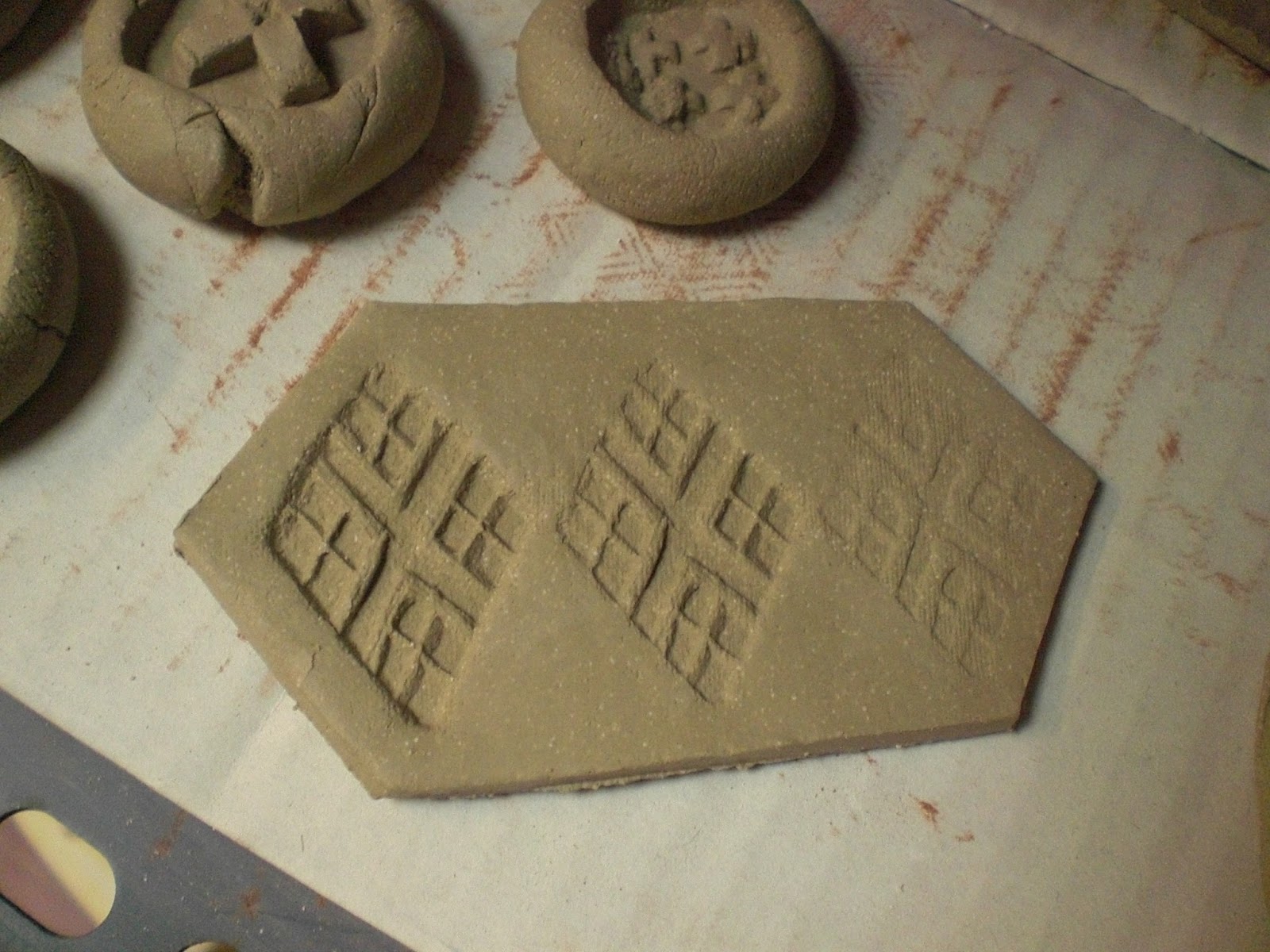
I made these round ceramic pieces with my plaster stamps, and they have been biscuit fired. I then decided to use these to push into squares of clay, to get a negative of the designs on the circles. this meant that as well as the original pattern from the stamps, it also transferred the surrounding circle.


I think these tiles could be used as wall decoration, set out in the same grid as the circles they got their pattern from.


Textile and mixed media: repeated diamonds.

 I have been looking at Polly Binns and Ealish Wilson, who both use a technique similar to smocking, but on a very large scale. Wilson uses various methods of securing her fabric, including cable ties and different threads.
 I tried out the same method, using embroidery thread to secure my calico. I knotted each piece of thread and left the tails long for added decoration.
 I then thought about possibly adding pieces to the textile backing, in the holes, so that there are smaller pieces of pattern, inside the textile.
 I have decided I would like to try to make quite a large wall hanging, so I wanted quite a few diamonds, to put in various places in the textile piece. I made diamonds from both clay and metal, using punches, enamel, pewter casting and reticulation to make the brass crumple and make a texture. I also used stamps to decorate some of the clay ones. I then used seed beads to weave one.


Tuesday, 21 May 2013

Ceramics: using plaster stamps

I made plaster stamps by pouring plaster into clay walls. The first stamp I made by carving the design into the plaster while it was still soft, and the other three I made by creating the design in clay, building walls around it and pouring the plaster in.
I then used these stamps to impress designs into slabs of clay. I tried to make regular patterns with the stamps, but also change the amount of pressure I put on the stamps to get different effects.
I also rolled balls of clay, and stamped one design on each, which I really liked because the random shape of the outside contrasted well with the very geometric stamp designs. I made 25 of these, to set out in a 5 x 5 grid, so they create a pattern when all put together.