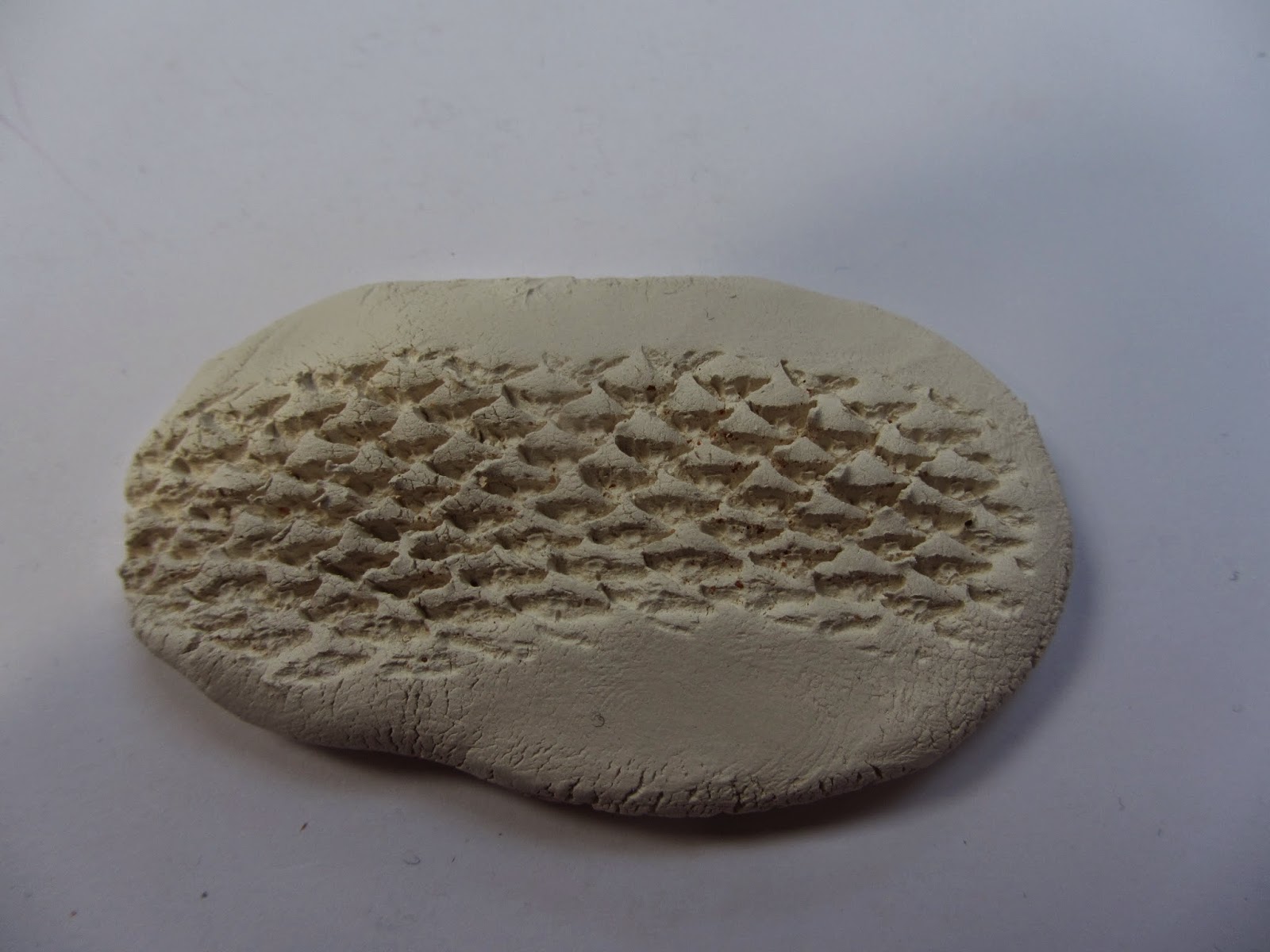
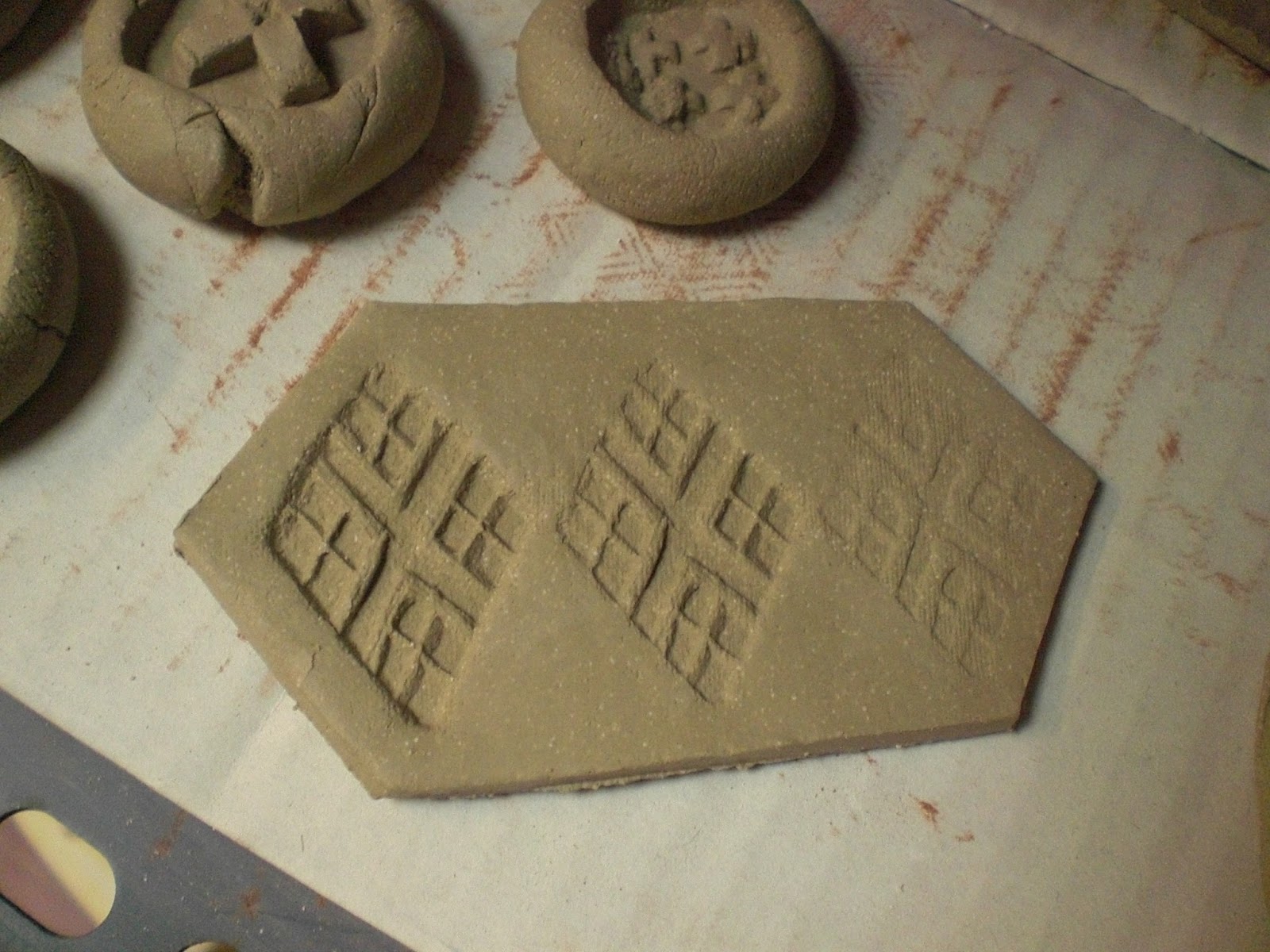
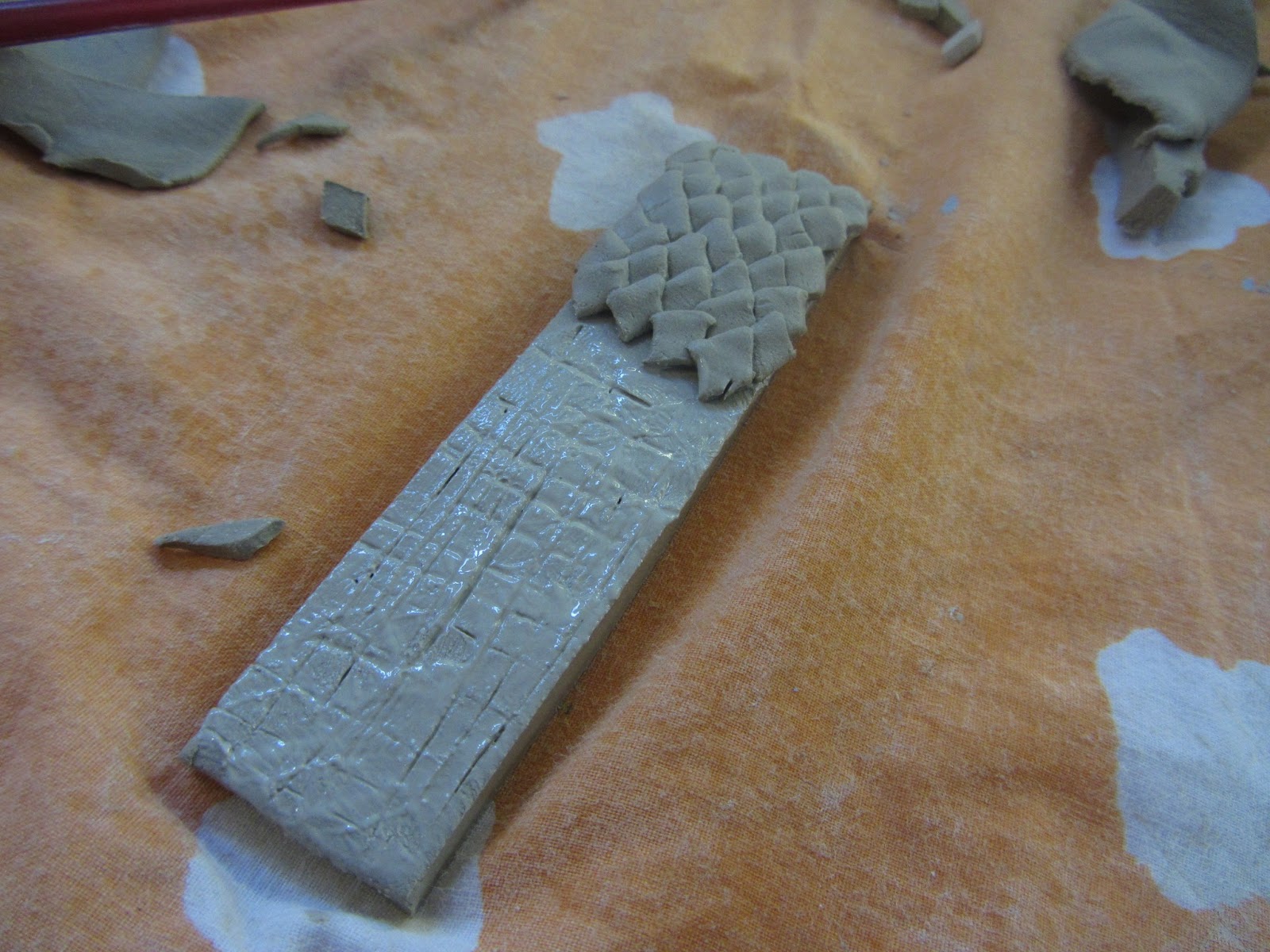
I have been experimenting with adding colour into porcelain slip. I've decided to colour the clay body, rather than adding a glaze or coloured slip on the surface, as I have been creating 3D textured pieces which I feel would lose their definition if I covered them. To get bright colours, quite a lot of underglaze needed to be added to the porcelain, because the porcelain is white, so all of the resulting colours would be tints.
I decided to test the colours at different temperatures as well as different concentrations of colour. Starting at 1g of underglaze to 100ml of porcelain slip, I also tested 2g, 3g and 5g. I poured out the slip onto plaster bats to dry, then cut each into 6 sections to fire at 1000, 1060, 1140, 1200, 1230, and 1260 degrees Celcius. I felt like this would give me a good overview of how the firing temperature and concentration alter the colour.
I used Picasso blue, black, turquoise, and lime green underglaze powders, and I plan to start mixing my own colours now I have a better idea of how they behave at different temperatures and concentrations. I remembered to label them before I fired them because I've made the mistake before of getting a beautiful result and forgetting how I got there!
I will make some texture tests with the coloured clay to see how the surface works with the colour, and I will also try putting underglaze powders into plastic clay rather than slip, to see if a uniform texture can be obtained by wedging it into the clay.
Showing posts with label ceramics. Show all posts
Saturday, 28 April 2018
Sunday, 12 April 2015
Ceramics: Textures and Slab Building
I then used a small pine cone to make a texture in slabs of clay. I like the repeated pattern that this creates and the small repeating shapes.
For a 3D piece, I used slabs of clay and built them up in layers to create a form with leaves in a regular pattern. I think this works well to create larger pieces, and I could maybe put textures onto the slabs before building the form.
Thursday, 30 May 2013
Ceramics: Creating pattern through repetition
I think these tiles could be used as wall decoration, set out in the same grid as the circles they got their pattern from.
Tuesday, 21 May 2013
Ceramics: using plaster stamps
I made plaster stamps by pouring plaster into clay walls. The first stamp I made by carving the design into the plaster while it was still soft, and the other three I made by creating the design in clay, building walls around it and pouring the plaster in.
I then used these stamps to impress designs into slabs of clay. I tried to make regular patterns with the stamps, but also change the amount of pressure I put on the stamps to get different effects.
I also rolled balls of clay, and stamped one design on each, which I really liked because the random shape of the outside contrasted well with the very geometric stamp designs. I made 25 of these, to set out in a 5 x 5 grid, so they create a pattern when all put together.
I then used these stamps to impress designs into slabs of clay. I tried to make regular patterns with the stamps, but also change the amount of pressure I put on the stamps to get different effects.
I also rolled balls of clay, and stamped one design on each, which I really liked because the random shape of the outside contrasted well with the very geometric stamp designs. I made 25 of these, to set out in a 5 x 5 grid, so they create a pattern when all put together.
Wednesday, 15 May 2013
Metalwork with ceramics: making a brooch.
For this brooch, I wanted to use my ceramic piece with diamonds on, but I didn't want the metal part to just hold the piece, I wanted it to be extra decoration and detail, not just functional. I decided to make a diamond shape to hold the ceramic piece, just by tension, not using glue or attaching it in any other way. this worked well, and I then soldered on a pipe along one edge, to hold a pin so that it could be a wearable item. I then made the pin, and cut another diamond to make an end for the pin, which would continue the pattern and theme further.
I made another brooch in a similar way, and I think these two brooches could be worn together, and depending on how they are positioned, could make other patterns.
Monday, 13 May 2013
Ceramics: Using coloured slip
I wanted to make a bangle, inspired by Erin lightfoot's ceramic bangles, but I wanted my pattern to be on the inside, Like the copper rings I made. I did this by painting patterns onto white clay using coloured slip, before making it into a bangle.For my first bangle, I decided to use the diamond shape I have been looking at, and use these as a base pattern, and put other more intricate patterns onto these. I used different types of pattern I have been looking at, animal pattern, pattern from process and patterns which have another purpose.
I then used the same method of painting with slip, but onto smaller pieces, which I then made into beads with pattern on the inside. I tried to keep the outside as plain as possible to contrast with the patterned interior.
This gave the inside edge a wobbly effect, which I quite like against the very clean line of the outside.
My last bangle just had pattern painted on all around the inside, with the hope that when it is being worn, it will look completely plain and simple, and only the person wearing it will know what is on the inside.
Wire work with ceramics and textiles
I wanted to include a textile element in one of my ceramic pieces, and also use metal to create a mixed media piece.I decided to use brass wire, and I made the wire frame curved, so as to be a statement necklace. I made the frame so the textile element could be woven through and sewn on to the wire. I used the large ceramic piece as the centre piece, and had two smaller ones on each side. I kept the colour scheme neutral so the ceramic pieces stand out and are the focal point. I pleated and stitched parts of the ribbon to add detail without taking the focus away from the ceramic pieces. I may add further textile parts to it at a later date, but I don't want to make it too busy and spoil the subtlety of it.
Tuesday, 16 April 2013
Ceramics: Natural pattern.
After a visit to West Midlands Safari Park, I started to think how pattern is used to hide animals in their natural habitat, and started thinking about how I could hide things in pattern, instead of hiding the pattern itself. I think this will make my jewellery a lot more patterned and decorative, but also keep the idea of hiding something in it, so what you see at first is not all that it is, and the jewellery will be more special and valuable to the person who owns it. I first looked at the pattern on zebras, and how this helps them to hide and be protected from predators I then thought how a zebra shape could be hidden in a patterned background, carrying on the stripes outwards.
I used a photo of a zebra I took at the safari park as a guide for the outline and stripes, then continued the stripes out, up to the edge of the piece of clay. when the clay was a bit drier, I carefully took the zebra shape out, then stuck the outside part onto another piece of flat clay with slip.
This made a base which the zebra fitted in, and could be taken out like a jigsaw piece. I am planning to fire them with the zebra in, using a powder to stop it from sticking. Because clay shrinks as it dries, when it is fired, the thicker base part may shrink at a different rate to the zebra, so it may not fit exactly, so by leaving the zebra in it, I am hoping that this will be less likely.
I have made two small tunnels on the back, which will hold the weight of the piece, which I hope to use as the centre piece of a necklace. I have left a gap between them, to leave space for a small metal clip, which will hold the zebra in place. I hope to use oxides when it has been fired, to make the indented stripes black, and leave the more prominent parts white.
I used a photo of a zebra I took at the safari park as a guide for the outline and stripes, then continued the stripes out, up to the edge of the piece of clay. when the clay was a bit drier, I carefully took the zebra shape out, then stuck the outside part onto another piece of flat clay with slip.
This made a base which the zebra fitted in, and could be taken out like a jigsaw piece. I am planning to fire them with the zebra in, using a powder to stop it from sticking. Because clay shrinks as it dries, when it is fired, the thicker base part may shrink at a different rate to the zebra, so it may not fit exactly, so by leaving the zebra in it, I am hoping that this will be less likely.
Labels:
ceramics,
clay,
hidden pattern,
jewellery,
jigsaw,
necklace,
pattern,
pendant,
stripes,
white clay,
zebra
Saturday, 30 March 2013
Ceramics: After glazing and firing.
I think the cabbage looks really good, because the stripes are straight when looked at from straight on, but the lines are wobbly when viewed from an angle.
I think this has worked really well with some parts shiny and some left matte, and also the very small detail with the larger pattern works really well together.
I think these squares worked really well, because they are so simple and not overly busy. I think together, the larger one in the middle and two smaller either side, would look good on a statement neck piece.
I like how this mosaic piece has turned out, the brown stain in between the tiles make it look old, like a roman floor.
The transparent glaze has worked really well on this woven piece. Because of the shine, I think it looks like a jewel, and the colours work well together.
I also like the matte piece, where the texture is the main feature and it is accentuated by the colours in the dents.
I was a little bit dissapointed that the darkening of the orange red parts, which I was hoping to be more vibrant.
I used the same colour on this piece, and this has come out a terracotta red, not the very dark brown that is on the edges of the diamonds. this could have possibly been because of the thickness of the glaze, or because it was on top of a glaze, so could not soak in to the clay.
I think this has worked really well with some parts shiny and some left matte, and also the very small detail with the larger pattern works really well together.
I think these squares worked really well, because they are so simple and not overly busy. I think together, the larger one in the middle and two smaller either side, would look good on a statement neck piece.
I like how this mosaic piece has turned out, the brown stain in between the tiles make it look old, like a roman floor.
The transparent glaze has worked really well on this woven piece. Because of the shine, I think it looks like a jewel, and the colours work well together.
I also like the matte piece, where the texture is the main feature and it is accentuated by the colours in the dents.
I used the same colour on this piece, and this has come out a terracotta red, not the very dark brown that is on the edges of the diamonds. this could have possibly been because of the thickness of the glaze, or because it was on top of a glaze, so could not soak in to the clay.
Subscribe to:
Posts (Atom)