Showing posts with label hidden. Show all posts

Monday, 10 February 2014

Self directed project.

I've just started semester two, and our new project is entirely self directed, we haven't been given a starting point, or a certain media to use, but we can sign up for whichever workshops we want to do. I've decided to continue researching the theme of unnoticed, which I've looked into quite a lot in the past. I've decided to focus on how art can make the unnoticed very obvious, or how artists can make something that goes overlooked because of its scale or how they present it. In my initial research I have looked at artists who use these themes.
 Susan Collis makes everyday objects, which are often overlooked in her exhibitions. Many people think the exhibition isn't set up yet, but in actual fact they haven't looked at the objects properly. 'As good as it gets' looks like a screw in a wall, but is made from 18 carat white gold, white sapphire, turquoise and onyx.

 'The oyster's our world' is a wooden stepladder, which looks like it's been splattered with paint, but the splashes are actually mother of pearl, shell, coral, fresh water pearl, cultured pearls, white opal and diamond inlaid into the wood. I think these works question the way we see things and how we assume things about what we look at without investigating them properly.
 Grace Eun Mi Lee is a ceramic artist, who looks at microorganisms and uses the shapes and patterns from these to inspire her work. I really like how she collects them together, hundreds of tiny pieces making up one monumental work of art. tiny creatures and dust particles are everywhere, thousands of them, and her work makes people thing about 'another form of existence' which coexist with us everyday.

The Boyle family are a family of artists, who are quite well known for their replicas of places. they travel to an exact spot and use various media and pieces they find on location to create exact copies. I think the thing I like best about these pieces is how they are displayed. These pieces are not recognisable pieces of land, they don't have specific defining features, but presenting them vertically, it makes people really look at the patterns and shapes, which ordinarily they would have walked over without a second thought.

Monday, 20 May 2013

Metalwork: Folding and using enamel

I started looking at how I could create some of the patterns I have been looking at, in a more three dimensional way, and experimenting more with materials instead of designing something and then making it. I wanted to try different techniques of making pattern and furthering my ideas that way, before deciding what jewellery or object the piece will be. I started looking at origami folding techniques, and looked at a jeweller, Lois Martens, who uses folding in her silversmithing.

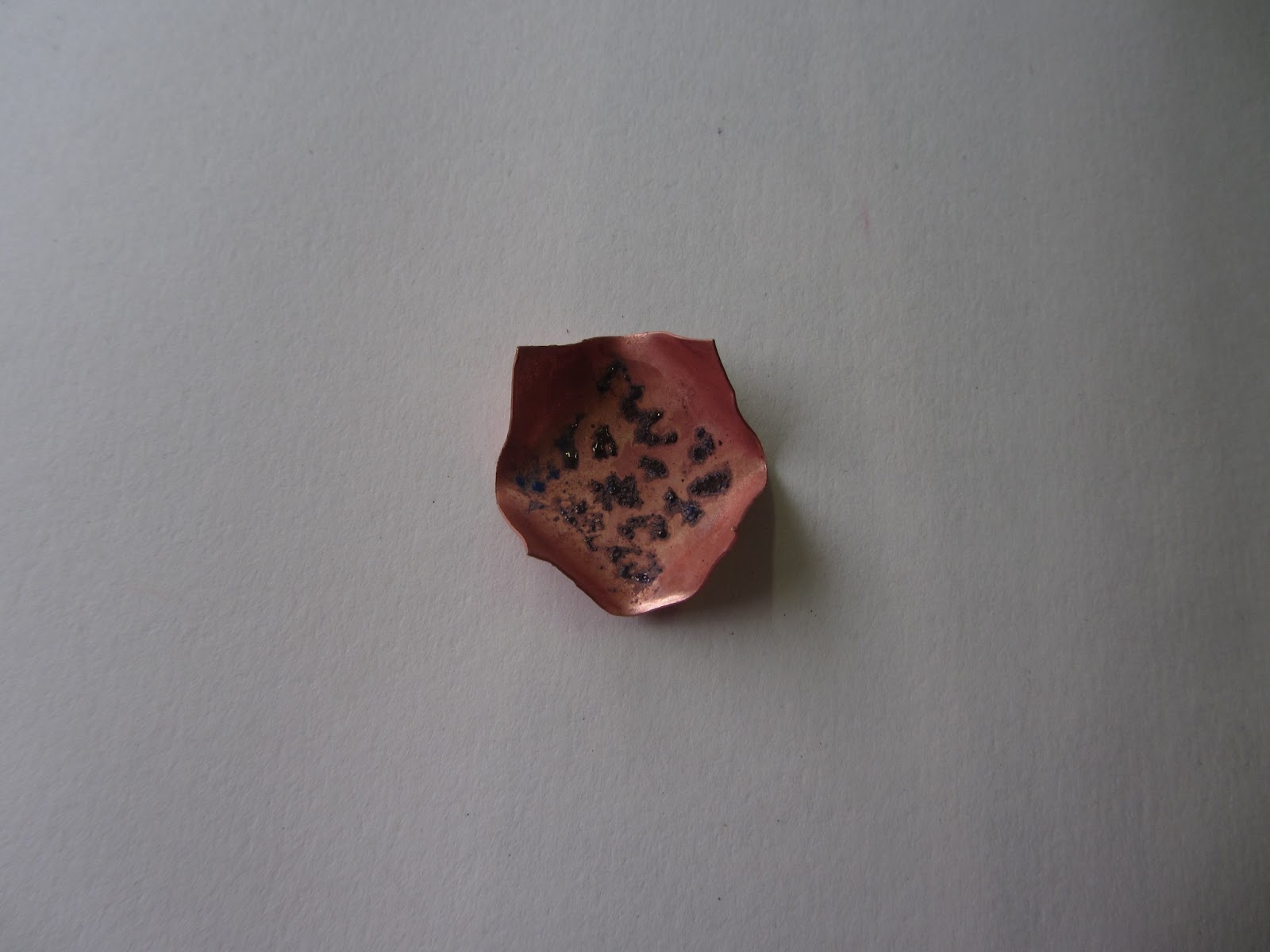
I then started experimenting with folding copper, and I found a shape I liked, which had a cross shape through it.

I then started thinking about how I could possibly decorate it, on the inside, so the pattern is only visible through the cross shape, I first thought about putting pattern onto the metal, before I folded it completely. I decided to try some enamel, but I only put it on the square part that shows through the cross.
I thought this worked very well, and was a good way of putting patterns directly onto the metal. I also tried putting paper squares into them with pattern on, and I found that looked good, but I think I would prefer a more intricate pattern on the paper, if it were to be made into a piece of jewellery.
I then decided to try some more enameling, because I think it has a texture and shine that contrasts well with the copper. I tried both putting pattern in the enamel, and some plainer ones, where I focussed on colour, rather than a regular pattern.

 To do this, I mixed the enamel with a little bit of water (keeping each colour separate) and used it like paint onto the copper. I did this with six copper squares, and left them for the water to dry before I heated them. The water has to completely dry out before heating, otherwise it would boil, and could cause the enamel to come off the piece. I used a blowtorch to heat each square until the enamel melted and went smooth and shiny.
I like using enamel because it changes when it is heated, and I find it very interesting to see how they look afterwards.
I folded the edges in before I put the pieces in the acid to get rid of the oxide on the copper.
I then put them together in a regular grid, so that it created another pattern of where the sides meet, and create little diamonds in a regular geometric pattern.


Wednesday, 15 May 2013

Metalwork: Making a copper bangle

I made this bangle with the same method I made rings before, by stamping patterns onto the strip of metal before I bent it into the right shape. I used a file to smooth out the marks that the punches had left on the other side. I wanted the outside to be completely plain and not patterned, to look simple and sophisticated
I started using a fairly rough file, to make it flat, and then smaller, smoother files to make the surface smooth. I decided I wouldn't polish it, because I wanted to keep the satin finish that I got from the wet and dry paper.
My main aim for this bangle is so that the pattern can only be seen when the bangle is not being worn, and much of the items beauty can only be seen by the owner of it.


Monday, 13 May 2013

Ceramics: Using coloured slip

I wanted to make a bangle, inspired by Erin lightfoot's ceramic bangles, but I wanted my pattern to be on the inside, Like the copper rings I made. I did this by painting patterns onto white clay using coloured slip, before making it into a bangle.

For my first bangle, I decided to use the diamond shape I have been looking at, and use these as a base pattern, and put other more intricate patterns onto these. I used different types of pattern I have been looking at, animal pattern, pattern from process and patterns which have another purpose.

I then used the same method of painting with slip, but onto smaller pieces, which I then made into beads with pattern on the inside. I tried to keep the outside as plain as possible to contrast with the patterned interior.
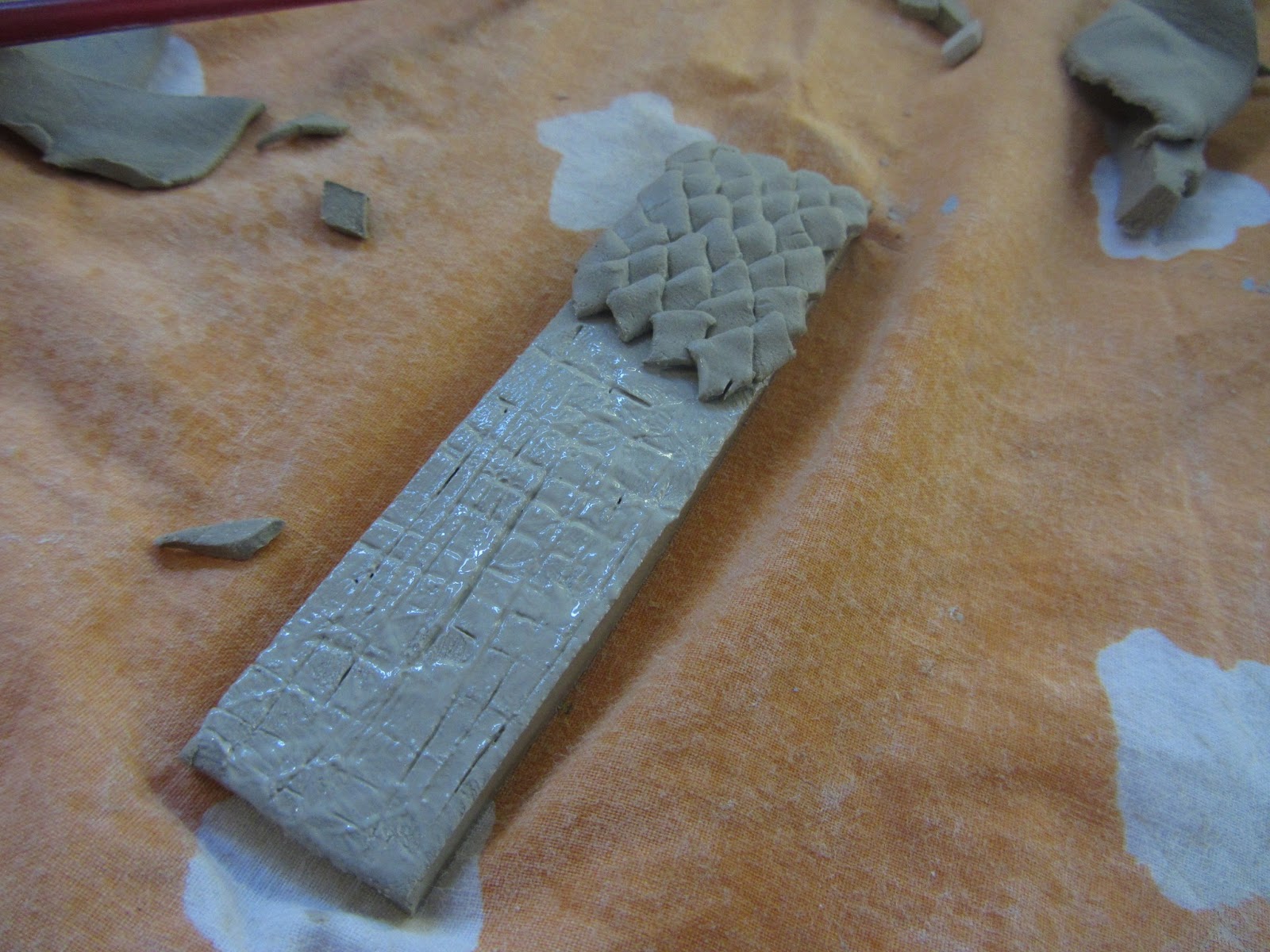
 I then wanted to experiment with putting texture on, so I decided to make a scaly, snake skin texture, because this used the same shape repeated so would make a regular pattern. Once I had put the texture on, I joined the ends and carefully cut so the outside was completely flat
 This gave the inside edge a wobbly effect, which I quite like against the very clean line of the outside.

 My last bangle just had pattern painted on all around the inside, with the hope that when it is being worn, it will look completely plain and simple, and only the person wearing it will know what is on the inside.

Wednesday, 13 March 2013

Final Major Project: Hidden Pattern

For my final major project, I have decided on the theme of hidden pattern. I have decided on hidden pattern because I enjoy looking at detail and I want to create unusual patterns, not just geometric patterns and shapes. I will first look at organic patterns, like patterns in vegetables and plants, and transfer the patterns and shapes from these to jewellery I will be making. Through my work I have done so far in applied arts, I have found I tend to lean more towards small scale detailed objects and jewellery, so I would like to continue with this way of working.
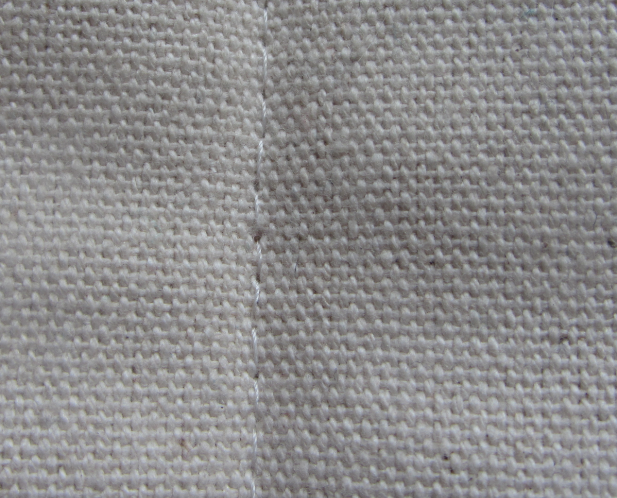
 I will look at pattern created by accident, such as from a collection of objects, or pattern that has another use, such as road markings. I would also like to look into pattern created from another process, such as weaving or knitting. The fabric may have a pattern printed on, but I will be looking at the pattern that is created from making the fabric. it is not deliberate and it often unnoticed, but I would like to use this kind of pattern as a focal point in my jewellery.
 I will also look at pattern which is deliberate, but may be unnoticed, such as the patterns on banknotes, which many people will handle everyday without noticing the pattern and decoration that makes them so difficult to forge.