Showing posts with label observational drawing. Show all posts

Wednesday, 25 September 2013

Culture meets Nature: Drawing

To continue on our theme of 'when culture meets nature' we each chose two words out of a hat, one was a natural thing, and one cultural. My two words were 'mountain' and 'shoes'. I started off by doing some observational sketches of shoes, both mine and other peoples.
I then sketched a mountain the best I could from memory (unfortunately I couldn't find a mountain in Wolverhampton) 
I then tried to combine the two, by making a 'mountain of shoes' starting with a pile of shoes, turning into a mountain further up
 Some close-ups of the drawing:


I then tried to combine them in a different way, by making the mountain into a shoe. I did this by putting laces up the side of the mountain, and trying to make it shoe shaped, while keeping the form of the mountain. I then cut away the excess paper to better show the shape.

Thursday, 27 December 2012

Pottery shards.


After looking at things people leave behind, I started to look further back, to people that lived hundreds of years ago, and started looking at archaeology and pottery pieces found in rivers and streams. I found artists who use pottery shards in their work including Tania Covo, who sets pottery pieces she finds in the thames in silver to make jewellery. I also looked at Cleo Mussi, who uses reclaimed pottery to make mosaics.


I collected some pottery shards from a river bank in Bradfield, and have been using these to base most of my project work on. The patterns and shapes have inspired my sketchbook work as well as my practical work, and I have also been using them for observational drawing and collage.


Sunday, 16 December 2012

Design visualisation: observational drawing and modelling.

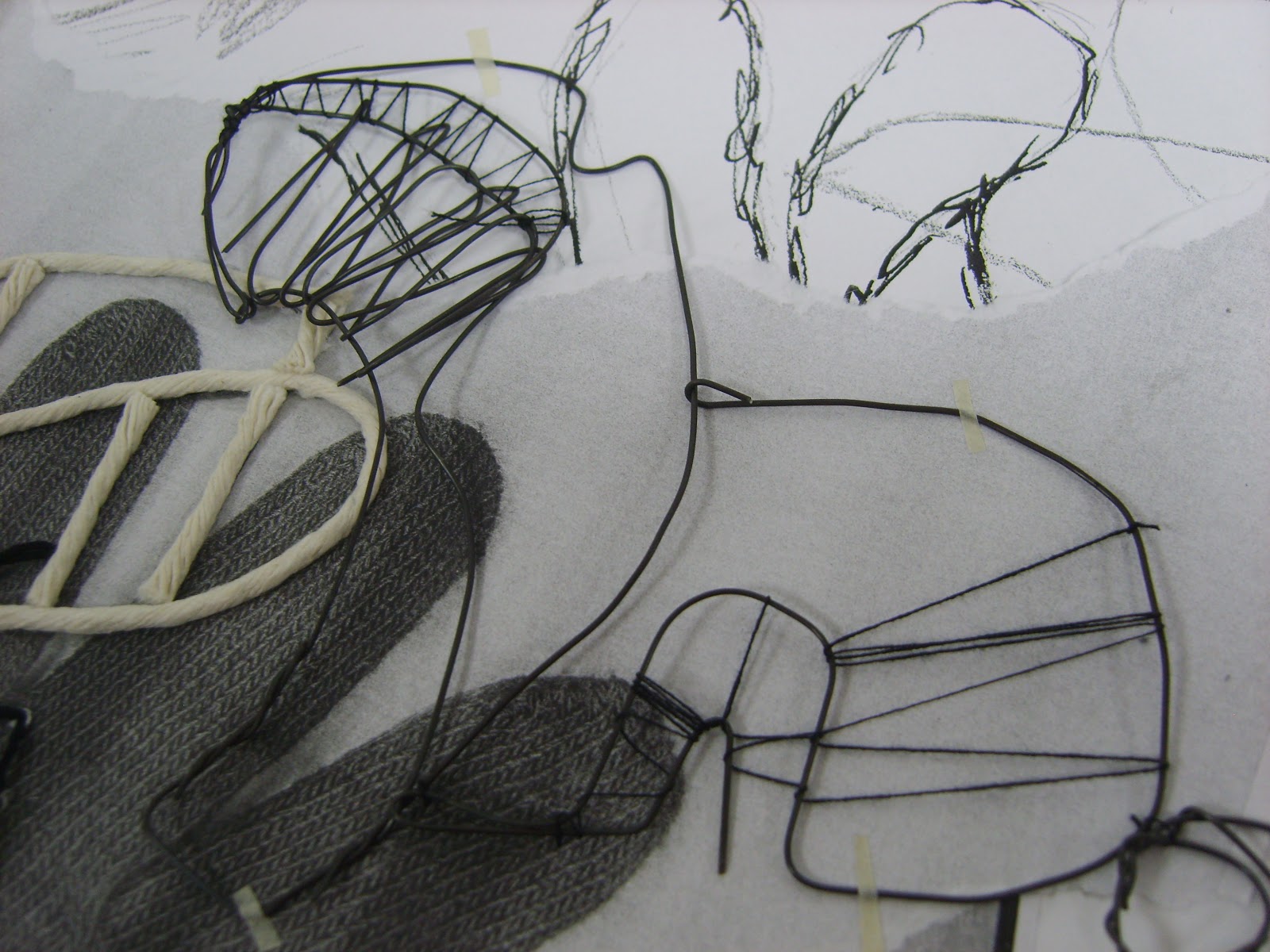
I decided to use a glove as the base for my observational drawing, to link with my theme of trace elements. A glove is often something people lose without noticing, if it falls out of a pocket, and it is a trace of the person who has been there.


I started off by using a graphite stick and pencil to do some quick sketches of the glove, in various different sizes and positions. I then used ink and collage to work into my drawing, to highlight interesting patterns and shapes.
I also did some separate quick drawings, to try to capture some of the different tones and shadows in the glove. 

After this, I started picking out some of the interesting patterns and shapes to make in wire. I found it difficult to bend very tight angles in the wire so some parts were more curved than I hoped they would be.

I then started to use black thread with the wire to create different thicknesses of lines, and some sharper angles. Some of the wire bits didn't look at all like a glove, but I found this was a good way to generate ideas from everyday objects, that could be used for jewellery or a printed pattern.

  After this, I started using collage, string, masking tape, sewing, and photocopies of the glove to create small object, taking ideas from my first drawing.

Saturday, 15 December 2012

Design visualistation: Observational drawing and modelling.

 For observational drawing, we were focussing on organic forms, so I chose this item, which I guessed was some sort of fruit, because I liked the repetitive nature of the surface,and the fact it is not one shape, but lots of little shapes that join together to make a whole.
 I used paper and masking tape to create cone shapes, and cut of the tops to emulate the shape of the fruit. I then used the cut off pieces to make smaller versions of the cones, and cut their tops off too. I attached them together with wire and thread.
 I then thought of using thread to draw with, so I stitched a simplified outline of some of the detail. I think this is quite effective, and would make a good pattern to repeat and use as a textile print or wallpaper.
 I used a barbecue skewer and ink to do a line drawing of the whole object, which created very thin lines and quite expressive lines because I was holding the skewer near the end.
 This drawing is a lot bigger, I wanted to show the end of it, not the side. I quite liked using the chalk, but it was hard not to smudge it when I was drawing other parts.
I think this one is my favourite drawings, it is a drawing of my larger paper model (top left corner), so I collaged some of the same paper onto the drawing, and also used chalk and ink to create the shading. I did the drawing on top of tissue paper, so there was a texture to the background, and I think all of this together makes it a very successful drawing.